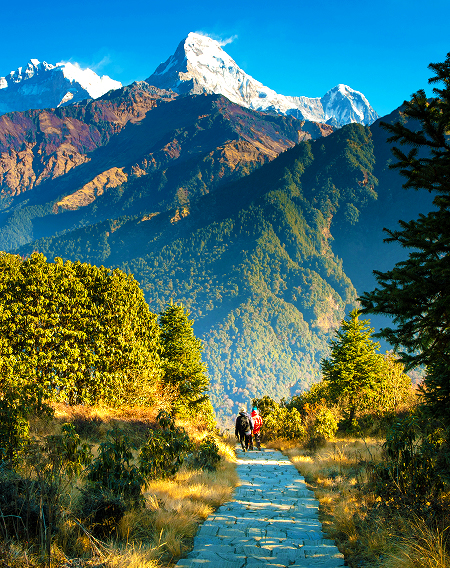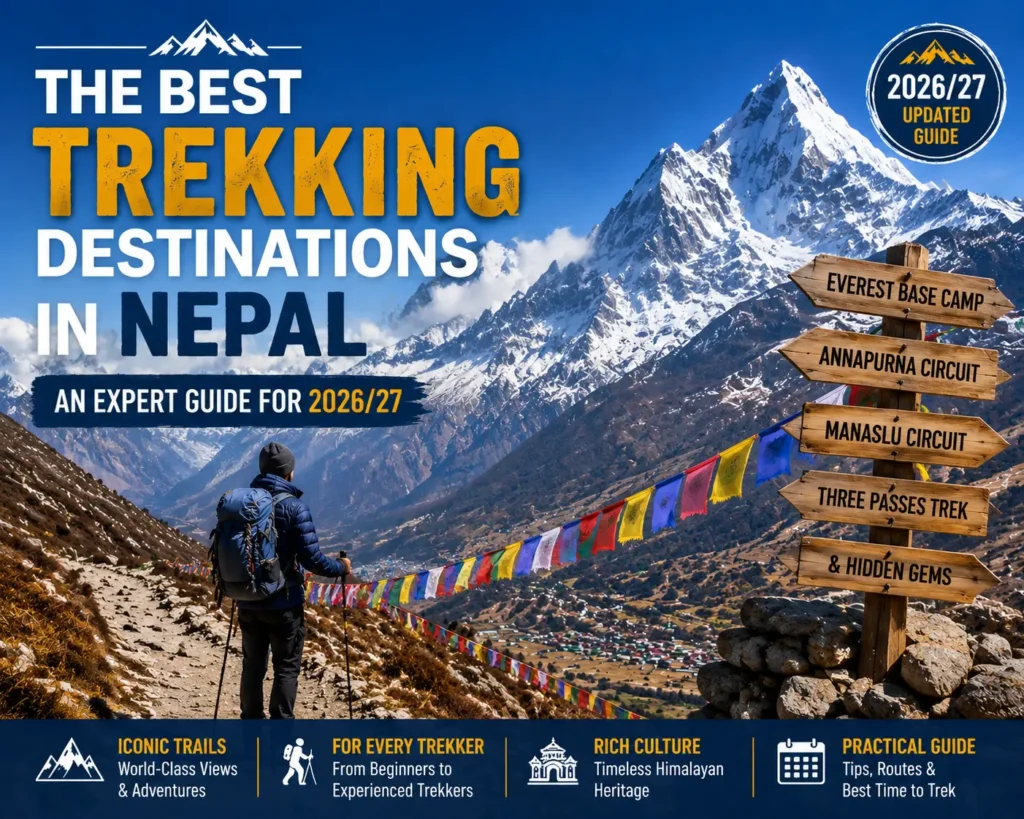
Nepal is the world’s best trekking destination, offering over 5,000 kilometres of trails across six major regions: the Khumbu (Everest), Annapurna, Langtang, Manaslu, Dolpo, and Kanchenjunga. The country holds eight of the world’s fourteen 8,000-metre peaks and provides teahouse-supported access to the base of most of them. Top trekking destinations include the Everest Base Camp Trek (14–16 days), the Everest Three Passes Trek (18–21 days), the Annapurna Circuit (14–18 days), Ghorepani Poon Hill (4–5 days), Langtang Valley (7–12 days), and the Manaslu Circuit (14–18 days). The best seasons to trek are October to November and March to April. Corsa Nepal Adventure, a government-registered, Nepal Tourism Board-licensed operator based in Kathmandu, offers guided packages across all these regions with all permits and logistics included.
Ready to start planning? Browse all trekking packages at Corsa Nepal Adventure or WhatsApp us directly at +977 9851 021 716.
Why Nepal Remains the World’s Premier Trekking Destination
Nepal holds eight of the world’s fourteen 8,000-metre peaks, yet what makes it extraordinary for trekkers is not just altitude. It is access. Nowhere else on earth can you walk to the base of the world’s highest mountains on well-maintained trails, sleep in teahouses with hot meals, and move through living Sherpa, Tamang, Gurung, and Thakali communities every single day.
The trail network spans over 5,000 kilometres across six major trekking regions. Three of those regions, the Khumbu (Everest), Annapurna, and Langtang, form the classic trekking triangle. The other three, Manaslu, Dolpo, and Kanchenjunga, represent the frontier: quieter, rawer, and increasingly popular among experienced trekkers who want depth over convenience.
Here is what the best trekking destinations in Nepal look like in 2026/27.
1. Everest Region, Khumbu — The Benchmark
No list of Nepal’s best trekking destinations starts anywhere else. The Everest region draws roughly 50,000 trekkers a year, and the numbers are justified. The Khumbu is visually and culturally overwhelming in the best possible way.
Classic EBC Trek
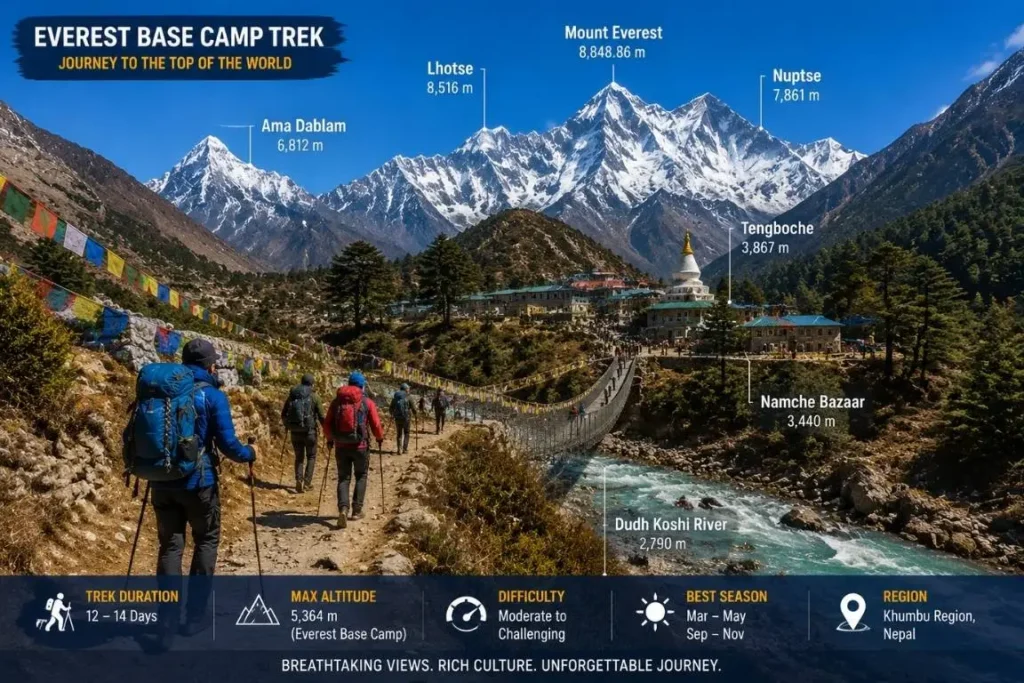
The route from Lukla to Everest Base Camp via Namche Bazaar, Tengboche, Dingboche, and Lobuche is the world’s most iconic high-altitude walk. Namche Bazaar, a remarkably cosmopolitan Sherpa market town at 3,440m, is alone worth the flight from Kathmandu. The Tengboche Monastery, set against the south face of Ama Dablam, is one of the most photographed places in the Himalayas. EBC itself is a glacial moraine rather than a dramatic summit viewpoint, but the pilgrimage quality of arriving there is genuinely powerful.
Our honest take: EBC is crowded on the main trail from October to November. The trail from Dingboche to Lobuche sees heavy teahouse queuing in peak season. If you want the classic route, go — but come with adjusted expectations about solitude.
Everest Three Passes Trek
For trekkers who want to move beyond the EBC highway, the Three Passes route (Kongma La 5,535m, Cho La 5,420m, Renjo La 5,360m) is arguably the finest multi-day trek in the entire Khumbu. You cross all three high passes, visit Gokyo Lakes (a turquoise chain of glacial lakes at 4,700–5,000m), stand on Gokyo Ri for a panorama of four 8,000m peaks, and descend through Thame, an authentic Sherpa village most EBC trekkers never see.
Best direction: Anti-clockwise (start via Kongma La, finish via Renjo La). Renjo La delivers the most dramatic Everest panorama of the three and is best saved for last.
Fitness requirement: Real cardiovascular fitness is needed. Three consecutive high-pass days are punishing. Acclimatise properly with a minimum of two nights in Namche.
Corsa Nepal Adventure offers the complete Three Passes Trek as a 20-day guided package with flexible acclimatisation days built in and small group sizes to preserve the trail experience.
2. Annapurna Region — Diversity Above All
The Annapurna region is Nepal’s most visited trekking zone, and for good reason. It packs more variety into a single permit area than most countries manage in their entire trail network. Snow-capped 8,000m peaks, subtropical jungle, the deepest gorge on earth (Kali Gandaki), ancient Mustang plateau landscapes, and the sacred temple of Muktinath all sit within the same conservation area.
Annapurna Circuit
Once one of the world’s great wilderness treks, the Circuit was partly compromised by road construction along the Kali Gandaki valley. The honest assessment in 2026: the lower sections involve stretches of road walking, and parts of the southern approach feel more like a road trip than a trek. However, the Thorong La crossing (5,416m), the upper Mustang landscape around Manang, and the final descent to Tatopani remain extraordinary. If you do the Circuit, go with an experienced guide who knows the alternative trail sections above the road. They make a significant difference.
Ghorepani Poon Hill Trek
Four to five days, beginner-friendly, rhododendron forests in bloom from March to May, and a sunrise view of Dhaulagiri (8,167m) and Annapurna South from Poon Hill that stops people mid-step. This is the ideal introduction to Himalayan trekking and one of the most emotionally satisfying short treks on earth. Perfect for families, first-timers, or trekkers short on time.
Annapurna Base Camp (ABC) Trek
The ABC route through the Annapurna Sanctuary, a glacier-ringed amphitheatre at 4,130m, is a classic for a reason. The final walk into base camp, with Annapurna I (8,091m) directly overhead, is one of the most dramatic approach marches in Nepal. 10–14 days, moderate difficulty, excellent teahouse infrastructure.
Corsa Nepal Adventure packages cover the full Annapurna spectrum, from a 5-day Poon Hill experience to the full 18-day Circuit with off-road alternatives.
3. Langtang Valley — The Underrated Gem
Langtang sits just 60km north of Kathmandu, yet it feels like a different world. The valley is deep, pine-forested, and dominated by Tamang Buddhist culture. Prayer flags, mani walls, and yak herders are constants on the trail. The village of Kyanjin Gompa at 3,870m is a supremely peaceful base for acclimatisation hikes. Tserko Ri (4,984m) above it offers views of Langtang Lirung (7,227m) that rival anything in the Khumbu.
Post-2015 earthquake, Langtang was devastated when the village was buried by an avalanche. The rebuilt community is resilient and deeply grateful to trekkers who return. Visiting Langtang is both an outstanding trek and a meaningful act of support for the local community.
Combined option: Pair the Langtang Valley Trek with the Gosaikunda Lakes (4,380m), sacred Hindu pilgrimage lakes, for a 12–14 day circuit that covers alpine meadows, Buddhist monasteries, and glacial lake scenery in a single itinerary.
Langtang Valley Trek is one of Corsa Nepal Adventure’s most recommended routes for trekkers with limited time who want authentic cultural immersion without the Khumbu crowds.
4. Manaslu Circuit — The Serious Alternative
If you have done EBC or the Annapurna Circuit and want something with less traffic and more depth, Manaslu is the answer. The circuit circumnavigates Manaslu (8,163m, the world’s eighth-highest peak) through remote Nubri and Tsum valleys, crossing Larkya La Pass at 5,160m. The teahouse infrastructure has improved significantly since 2018, but sections of the trail remain genuinely wild.
Manaslu requires a restricted area permit and a licensed guide — non-negotiable by Nepali law. This barrier keeps numbers manageable and the experience more authentic. The upper Budhi Gandaki valley section, approaching Samagaon, ranks among the most scenically dramatic days of walking in all of Nepal.
Corsa Nepal Adventure’s Manaslu Round Trekking package includes all permits, experienced local guides, and carefully planned teahouse bookings for the restricted sections.
5. Upper Dolpo — For the Truly Adventurous
Upper Dolpo is where Nepal’s trekking frontier truly begins. The most remote region covered in this guide, Dolpo sits in the rain shadow of the Himalayas, a high-altitude Tibetan plateau landscape that receives almost no monsoon rainfall. The culture here is pre-Buddhist Bon as well as Tibetan Buddhist. The villages feel genuinely medieval, and Phoksundo Lake, a cyan jewel at 3,611m, is one of the most beautiful bodies of water on earth.
Upper Dolpo requires a restricted area permit, a mandatory licensed guide, and serious logistical preparation. Camping is required in large sections. This is not a teahouse trek. It is a full expedition and should be planned accordingly.
Corsa Nepal Adventure’s Upper Dolpo Trekking package covers the full logistics: restricted permits, camping equipment, experienced high-altitude guides, and a crew with deep regional knowledge.
How to Choose the Right Trek in Nepal : A Practical Framework
The right answer depends entirely on your fitness, timeframe, and what you want from the experience. Here is how to filter:
| Your Priority | Best Trek Match |
| First trek in Nepal, limited time | Poon Hill (4–5 days) or Langtang (7–10 days) |
| Classic Everest experience | EBC Trek (14–16 days) |
| Maximum Khumbu scenery, serious fitness | Three Passes Trek (18–21 days) |
| Crowd-light trails, authentic culture | Manaslu Circuit or Langtang Valley |
| True wilderness, full expedition | Upper Dolpo (18–25 days) |
| Cultural depth with scenic variety | Annapurna Circuit (with off-road sections) |
Best Time to Trek in Nepal 2026/27
- October to November: Peak season. Crystal-clear skies, stable weather, full teahouse availability. Trails on EBC and Annapurna routes are busy.
- March to April: Second-best season. Rhododendrons in bloom at lower elevations make the trek more mesmerizing. Slightly longer days. Annapurna and Langtang are especially beautiful.
- December to February: Cold but quiet, best for trekkers who want to escape and blend into nature. High passes may be closed (Three Passes, Thorong La). Lower altitude treks like Poon Hill and lower Langtang are viable with the right gear.
- May and September: Shoulder season — less crowded, reasonable prices, but some cloud cover and occasional precipitation around trekking days.
Acclimatisation: The Non-Negotiable
Every high-altitude trek above 3,500m requires proper acclimatisation. The standard protocol: ascend no more than 300–500m of sleeping altitude per day above 3,000m, and take a rest day every third or fourth day. Acute Mountain Sickness (AMS) is common at altitude. High Altitude Pulmonary Edema (HAPE) and High Altitude Cerebral Edema (HACE) are life-threatening conditions that develop when trekkers push too fast.
The most dangerous thing you can do is rush a schedule because of a flight deadline. Build buffer days into your itinerary. A slow trek is a successful trek.
Independent Trek vs. Guided Trek: The Real Trade-offs
| Factor | Solo/Independent | Guided with Corsa Nepal |
| Flexibility | High | Medium-High (options built into itinerary) |
| Safety net | Lower — AMS decisions and navigation are yours alone | High — guides are certified in wilderness first aid |
| Cultural access | Limited to teahouse interactions | Deep — local guides provide context on monastery protocols, trail history, and village life |
| Cost | Lower upfront | Better overall value (guides prevent costly mistakes and missed experiences) |
| Permits | Self-managed | Fully handled |
| Off-route access | Often missed | Local knowledge unlocks hidden villages and viewpoints |
A licensed, experienced guide is never just a navigator. On restricted trails like Manaslu and Dolpo, they are the single most important factor in your safety and the richness of your experience.
Why Book with Corsa Nepal Adventure?
Corsa Nepal Adventure is a Kathmandu-based, government-registered trekking company with over a decade of experience operating across all six major trekking regions of Nepal. Every guide is Nepal Tourism Board-licensed, trained in altitude medicine, and from the communities you will be walking through. That local knowledge is irreplaceable.
Our packages are built around what matters to serious trekkers:
- Fully customisable — dates, pace, side trips, and difficulty adjusted to your needs
- Transparently priced — all permits, teahouse bookings, and guide/porter fees included upfront
- Small-group by default — group sizes capped to preserve the trail experience
- Genuinely responsive — WhatsApp us at +977 9851 021 716 and get a real answer from a human within hours
We operate EBC, Three Passes, Annapurna Circuit and ABC, Poon Hill, Langtang Valley, Gosaikunda, Manaslu Circuit, Tsum Valley, Upper Dolpo, and more. If it is a trail in Nepal, we walk it.
Start Planning Your Nepal Trek Today
Nepal has the right trail for every level of trekker. The Khumbu will humble you. Annapurna will show you why trekking became a global phenomenon. Langtang will give you cultural depth within a week. Manaslu will remind you what mountains felt like before the crowds arrived. Dolpo will feel like stepping into another century.
All of it is within reach. All of it is better with a local guide who knows the land intimately.
Explore all Nepal trekking packages at Corsa Nepal Adventure and find the route that fits your timeline, fitness, and ambition.
Prefer to talk it through first? WhatsApp our team at +977 9851 021 716 for a no-obligation conversation about your options. We help you choose, we handle the logistics, and we make sure you come back having done the trek right.
Plan your custom Nepal trek now.
All treks operate subject to Nepal government permit regulations. Restricted area treks including Manaslu, Dolpo, and Upper Mustang require a licensed guide by law. Corsa Nepal Adventure handles all permit paperwork on your behalf.
Written by the Corsa Nepal Adventure team — licensed trekking guides and expedition specialists based in Kathmandu, Nepal.